Does the H.G. Wells Sci-Fi Classic Hold Up?
The 1960s film adaptation of H.G. Wells’ The Time Machine hooked me as a kid. Even with a spotty memory and a short attention span, it left enough of a mark that I was genuinely excited for the 2002 movie starring Guy Pearce.
If you are a dedicated ClayReader, you know I love the science fiction genre and am currently working my way through a master list of classics to become better read. Today, we are checking another milestone off the list with The Time Machine by H.G. Wells. Let’s dive in, shall we?
The Setup: Time as the Fourth Dimension
The Time Machine has an incredibly effective hook. The main character, known only as the “Time Traveller,” claims to have built a machine capable of moving through time. His dinner guests initially treat the title as a mocking joke, but it quickly becomes a title of absolute respect as the story unfolds.
At a dinner gathering, the Time Traveller explains his theory that time is simply a fourth dimension and demonstrates a small, working model of his machine. As a modern reader, I found this to be a highly compelling and grounded metaphor to explain time travel.
Prefer to listen instead of read? 🎧
Get the audiobook version of our favorite reads for FREE when you try Audible Premium Plus.
Start Your 30-Day Free TrialAs an Amazon Associate, ClayReads earns from qualifying purchases.
Welcome to 802,701 A.D.
Exhausted, injured, and visibly shaken, the Time Traveller later returns to the same group of men to recount the journey he has just survived. He traveled far into the future, arriving in the year 802,701 A.D.
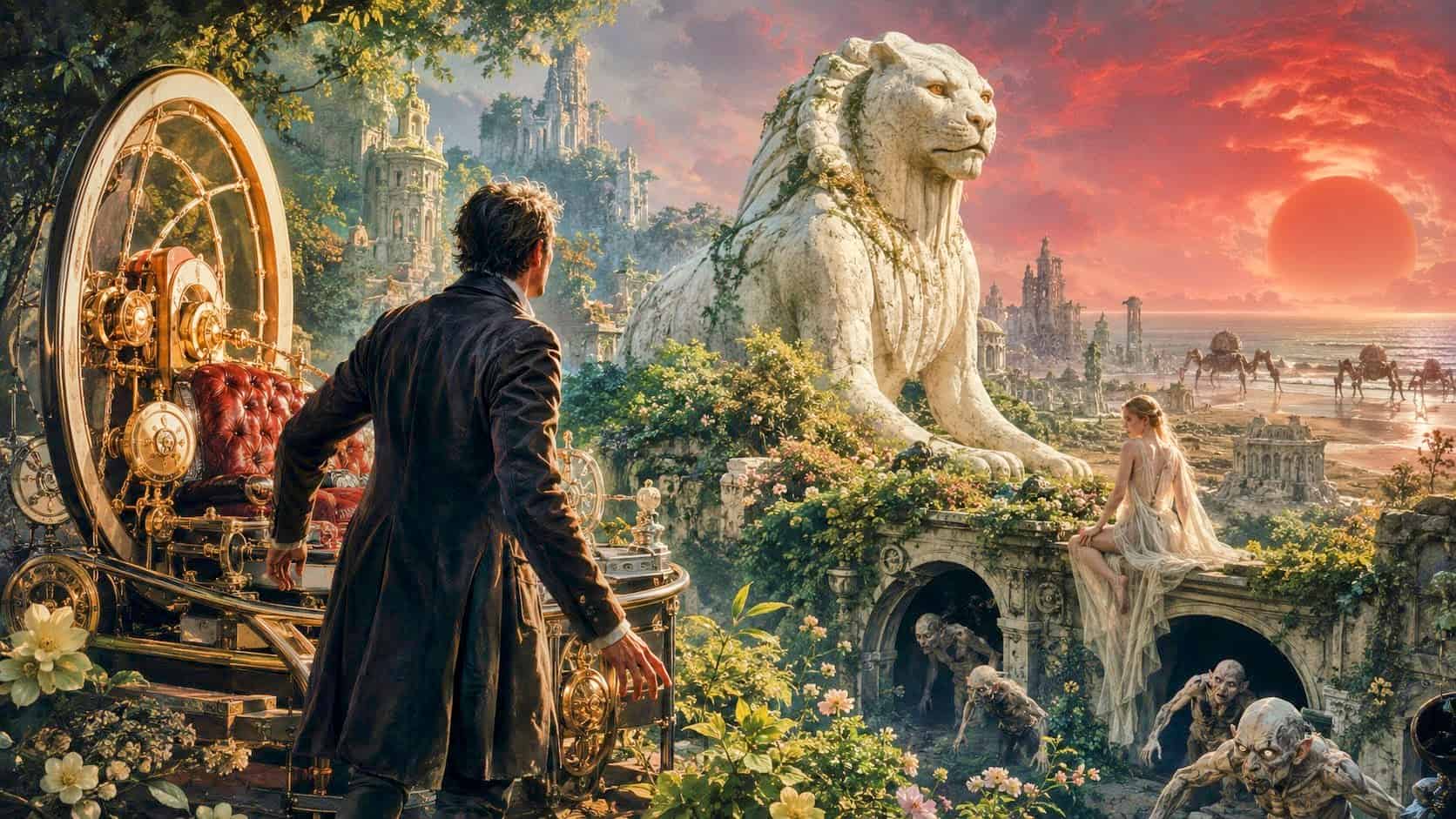
There, he finds a seemingly peaceful world inhabited by the Eloi, a gentle, childlike people who live aboveground among decaying buildings and lush gardens. At first, he believes humanity has evolved into a carefree species after finally overcoming labor, war, and hardship.
Side Note: While reading this section, my brain kept flashing back to visuals from the movie adaptations I haven’t seen in decades. I found myself constantly anticipating plot points.
The Eloi and the Morlocks: A Cliché Wells Invented
The plot kicks into gear when the time machine vanishes. The Time Traveller eventually realizes it has been dragged into the base of a massive White Sphinx. While trying to recover his only way home, he discovers that the Eloi are not alone.
A second species, the Morlocks, lives underground in dark tunnels, operating machinery and only emerging at night. The Time Traveller gradually understands that the Eloi and Morlocks are both descendants of humanity, split into two radically different forms based on ancient class divisions.
Taking class division to the extreme where two distinct human races evolve feels like a massive science fiction cliché today. Nature just seems much more complex than this. However, it is almost unfair to hold that against The Time Machine, because H.G. Wells is probably the guy who essentially invented this trope.
Weena, the Palace of Green Porcelain, and the End of the World
During his stay, the Time Traveller rescues an Eloi woman named Weena, who becomes attached to him and follows him on his journey. I’ll be honest: I couldn’t get over the name Weena. It was incredibly distracting every time I read it. Maybe that makes me ten years old, but it took me out of the story.
Setting the names aside, the climax is fantastic. The Time Traveller explores the ruins of a great museum called the Palace of Green Porcelain to scavenge weapons against the Morlocks. After a terrifying confrontation at the White Sphinx, he escapes in his machine but accidentally launches himself even farther into the future.
Here, he witnesses the Earth in its dying ages. The imagery is unforgettable:
- A fading, bloated red sun.
- Strange, monstrous crab creatures roaming the beaches.
- A world nearly emptied of all life.
These were incredibly cool scenes with a heavy, melancholy atmosphere that you don’t usually see in modern blockbuster sci-fi.
The End of the Timeline
Eventually, the Time Traveller escapes back to his own time and tells his story to his guests. Most of them doubt him, but the next day, the narrator runs into the Time Traveller just as he is packing his bags to go on another adventure, never to be seen again.
The Time Machine is a foundational science fiction story that has been told and retold across countless mediums. I went into it not expecting much from a book published in 1895, but I genuinely loved it. The dinner-party framing device was unique, the duality of human evolution holds up as a cool concept, and the bleak ending at the edge of time was a masterpiece.
Have you read The Time Machine? Does it hold up for you, or do you prefer the movies? Drop your thoughts in the comments below!


 using WordPress and
No responses yet