Are We in a Crisis?
I’ve managed to stumble into another heavy sociology and history book. It was largely accidental, though I’ll confess a small part of me did it on purpose. I’m referring to The Fourth Turning: An American Prophecy by William Strauss and Neil Howe.
Between all the financial podcasts and digital asset deep-dives I consume, the hosts often speculate about whether we’ve actually entered the “Fourth Turning.” I could usually piece together the implications for America’s future through context, but I mostly suspected the podcasters were just trying to sound sophisticated without having actually cracked the spine. Still, I wanted to sharpen my own perspective on Strauss and Howe’s generational theory, so I decided to brave the text myself and see what the fuss was about. Let’s take a look.
Prefer to listen instead of read? 🎧
Get the audiobook version of our favorite reads for FREE when you try Audible Premium Plus.
Start Your 30-Day Free TrialAs an Amazon Associate, ClayReads earns from qualifying purchases.
Societal Cycles: History Has Four Seasons
The core premise of Strauss and Howe’s work is that history doesn’t move in a straight line; it moves in cycles. While they focus heavily on the American experience, they suggest these rhythms aren’t necessarily unique to us.
Even as technology, warfare, and political factions evolve, the way generations interact, and the tension between the individual and the collective, creates a predictable, recurring beat across roughly the span of a long human life.
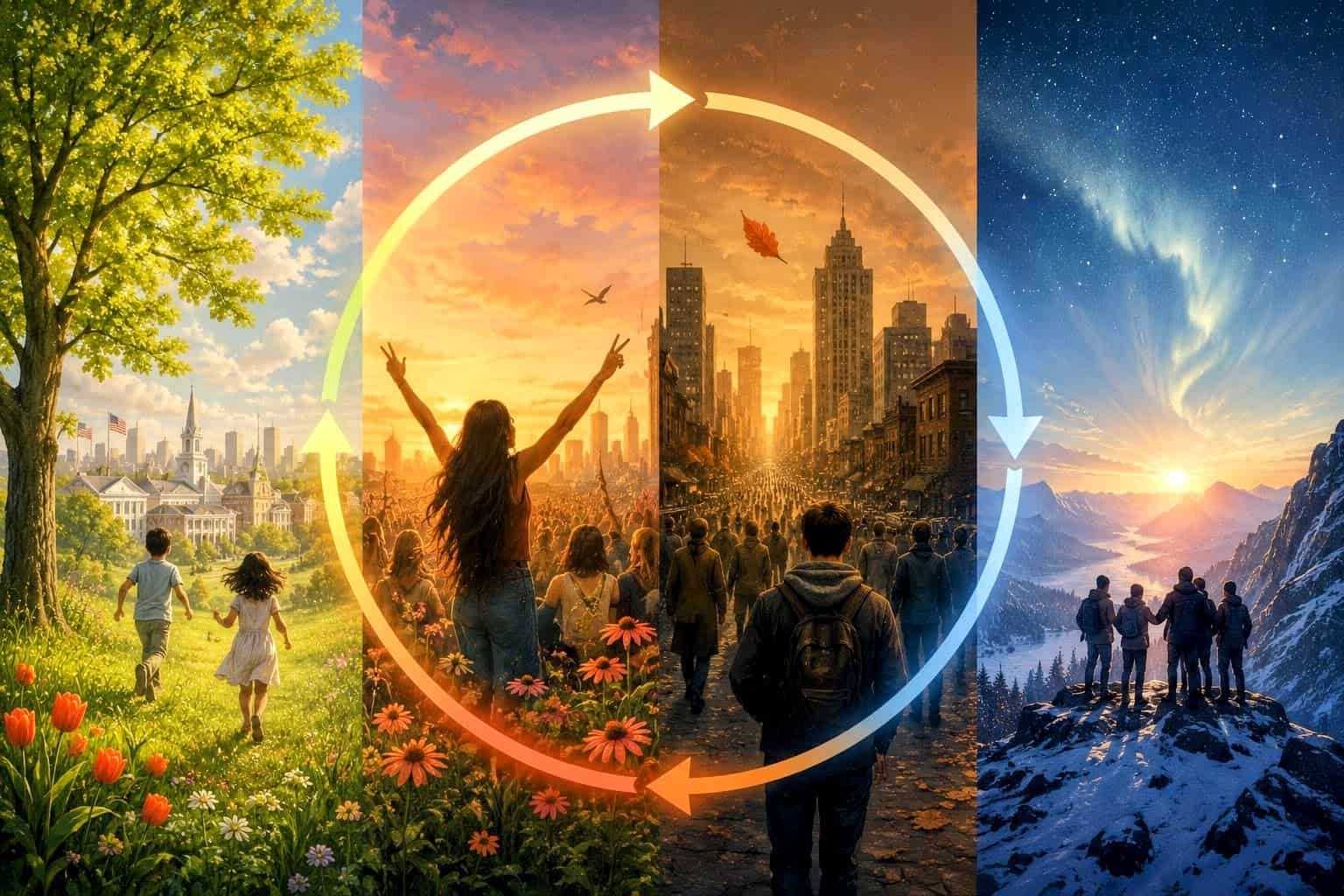
These cycles are broken down into four distinct periods called turnings. Think of them as seasons. Here is the cheat sheet:
| Turning | The Season | The Vibe | Historical Example |
| 1st (The High) | Spring | High trust, strong institutions, weak individualism. Conformity rules. | Post-WWII America (1946–1964) |
| 2nd (Awakening) | Summer | High individualism, spiritual exploration, rebelling against the “High.” | The Counterculture of the 60s/70s |
| 3rd (Unraveling) | Fall | Cynicism, decaying institutions, hyper-individualism. “Me” over “We.” | The 1980s–2000s |
| 4th (Crisis) | Winter | Institutions collapse, existential threats, society mobilizes for survival. | American Revolution, WWII… Today? |
The First Turning: The High
Think of the First Turning as the ultimate societal hangover cure. You just survived a massive crisis (like WWII), so everyone bands together to build solid, boring, reliable institutions. Public trust is elevated, and there’s a collective sense of moving toward a shared national destiny. The postwar American era between 1946 and 1964 is the primary example here.
But that stability requires a trade-off. When society demands everyone pull in the same direction, there is very little tolerance for those who don’t fit the mold. This friction eventually triggers the next phase.
The Second Turning: The Awakening
A new generation comes of age within this rigid, institutional world and begins to ask a very natural question: Is this really how we want to live?
The focus shifts from civic building to personal liberation, culture, and spirituality. Suddenly, young people are dismantling the very institutions their parents sacrificed to create. Society becomes much more fragmented, defined by the counterculture, the sexual revolution, and a total rejection of postwar conformity. Trust in authority plummets as the culture pivots toward individualism.
The Third Turning: The Unraveling
If the Awakening was the rebellion, the Unraveling is the messy aftermath. Individualism reaches its absolute peak, and public institutions hit rock bottom in terms of efficacy and trust. Skepticism becomes the default setting for everything—government, business, and media. The collective “we” is replaced by an atomized “me.”
When The Fourth Turning was written in 1997, the authors argued America was deep in this unraveling era. And they warned that a cold season was approaching.
The Fourth Turning: The Crisis
This is the transformational period that gives the book its title. The authors argue that when an Unraveling has sufficiently weakened society’s foundations, a major threat, a catalyst, triggers a shift in the national mood. Suddenly, the status quo becomes completely untenable.
The priority shifts from private life back to public survival. Individualism is traded for collective mobilization. Old systems are dismantled, and new ones are forged in the heat of the moment. In these eras, the stakes are nothing less than the survival of the civic order. Historical examples include the American Revolution, the Civil War, and the era of the Great Depression and World War II.
Once the resolution is reached and the crisis passes, a new High begins. The wheel turns, and the cycle starts anew.
Generations Are the Engine Behind the Cycle
The main thesis of this book is that these cycles don’t just happen by magic; they are based on human generations. People who grow up in different historical “seasons” develop vastly different views on authority, risk, and community.
As these groups move through the various stages of life, from youth to elderhood, they carry those values with them, inevitably clashing and collaborating in ways that move the cycle forward.
Are We in The Fourth Turning Right Now?
This brings us back to the “prophecy” part of the subtitle. When the book was published in 1997, Strauss and Howe were looking at the generational alignment and concluded the Unraveling was nearing its end. They predicted that around 2005, give or take, a catalyst would plunge America into its next Fourth Turning.
They didn’t pretend to know what the spark would be, it could be a financial collapse, a war, or a domestic political struggle. Looking back, was it the War on Terror? The 2008 financial collapse? COVID-19? It definitely begs the question: Are we right in the middle of a Fourth Turning today?
My Read
Two phrases have been living in my head lately and are probably responsible for me picking up this book: ‘Time is a flat circle’ and ‘History doesn’t repeat itself, but it rhymes.’ I have been pondering these quotes for a while, thinking about how I could use what I have experienced to leverage my future into bigger and better things.
The fact that The Fourth Turning is grounded in the idea that history repeats in these cycles because of different generations of humans and how society ages is what makes me buy into the authors’ arguments. The rest of their descriptions and evidence notwithstanding, it was definitely written for an academic reader who wants to engage in a philosophical discussion. Whether there are four turnings and if we have entered the fourth turning is besides the point to me. I think we can learn from these generational patterns and become a better society from them.
Now, after reading this book, the question that is on my mind: Has technology grown to the point where it can break these cycles? Is information persistence and access enough for human generations to learn from past mistakes? Can AI level the generational upheaval?
Let me know what you think in the comments below!




 using WordPress and
No responses yet