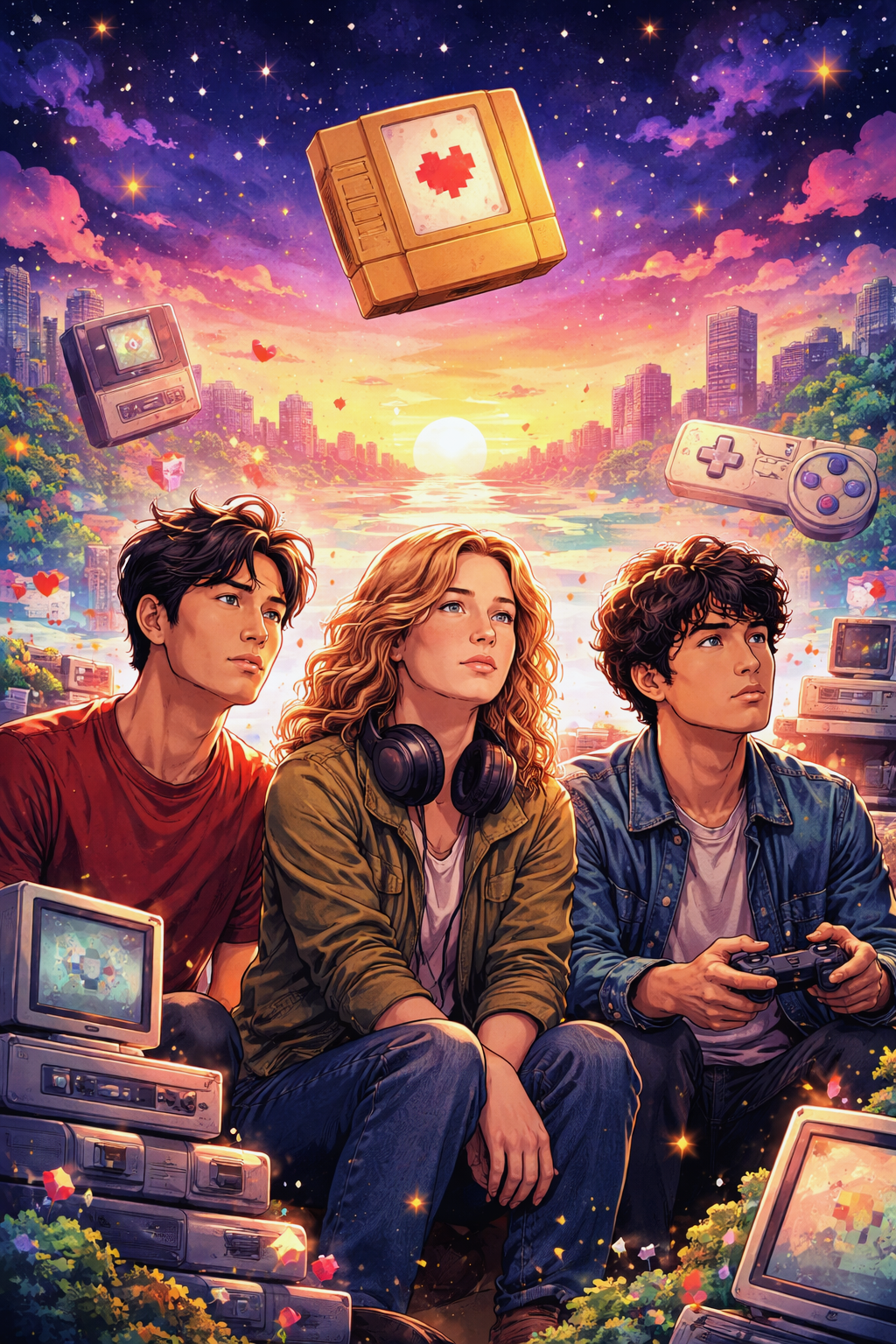
A Love Letter to Gaming and Friendship
I have to admit something before we get into the review: I saw Tomorrow, and Tomorrow, and Tomorrow by Gabrielle Zevin everywhere, and the fact that it involved video games seeped into my consciousness. Without reading anything else about it, I mistakenly came to the book thinking it was a science fiction book.
And boy, was I wrong.
It is a contemporary literary fiction book in all the best ways. And spoiler alert: I loved it. I feel it was written for my generation; the characters were a few years older than I am (huge age reveal), and their experiences were very nostalgic to me.
Enough about me, let’s dive into the book.
The Verdict (Spoiler-Free)
If you haven’t read the book yet, here is the bottom line: Read it. Even if you aren’t a “gamer,” Zevin’s writing transcends the subject matter. It isn’t just about coding; it’s about the grueling work of creativity and the messy, non-romantic love that exists between lifelong friends. The prose is accessible but sharp, and the pacing is relentless.
🚨 SPOILER WARNING: DEEP DIVE & PLOT SUMMARY BELOW 🚨
(If you haven’t read the book, turn back now! We are discussing the ending, the deaths, and the twists.)
The Early Bond: A Hospital, a Console, and a Friendship That “Saves”
The story begins in the 1980s with Sam Masur and Sadie Green meeting as kids in a pediatric hospital. Sadie is there because her older sister, Alice, is receiving treatment for leukemia. Sam is there for repeated surgeries after a car crash killed his mother and crushed his foot, leaving him in long-term pain and disability. In the hospital game room, video games become their shared refuge, and, for Sam, a pathway back to speaking again.
That origin story matters because it sets the pattern for everything that follows: games aren’t just entertainment for them. Games are how they connect, how they cope, how they express affection, and how they survive the parts of life that feel unplayable.
But even this foundation cracks. Sadie’s time with Sam is initially tied to a community-service requirement for her bat mitzvah, and when Alice reveals Sadie’s “tallying” of hours to Sam, it lands as humiliation. A friendship built on trust suddenly looks transactional.
Reconnection in Cambridge: The Spark Returns
Years later, Sam (now a student at Harvard) runs into Sadie again in Cambridge. The reunion reignites what they had as kids: not just friendship, but creative electricity. Sam’s roommate and close friend Marx Watanabe quickly becomes part of the trio’s gravitational field, he is the “NPC” (non-player character) who grounds them, understanding both the art and the logistics, the dream and the deadline.
What begins as a reconnection becomes a plan: make something together. Not a school project. Not a hobby. A real game, built on the intensity of their shared history.
Unfair Games and the First Blockbuster: Ichigo
Sadie ends up living with Sam and Marx, and they convert their apartment into the beginnings of a studio: Unfair Games. Their breakout project is Ichigo, an adventure game about a child lost at sea trying to find a way home. The premise echoes the book’s emotional engine: disorientation, longing, and the hope that if you keep moving you’ll eventually reach something like safety.
Making Ichigo also introduces one of the novel’s key tensions: who gets to control the story. The game’s development hits a technical wall, and Sam pushes Sadie to reach out to Dov Mizrah, her former professor and an influential figure in games. Dov becomes both a professional solution and a personal complication.
This is a pivotal moment for the characters’ relationship: Sam knows, or at least strongly suspects, that Dov was abusive toward Sadie, yet he pushes for the connection anyway to save the game. It creates a fault line in their trust that never fully heals.
Ichigo becomes a pop-culture phenomenon. Their lives change overnight: money, attention, and celebrity. But Sadie runs into sexist assumptions about authorship, with the public treating Sam as the “real” mind behind their work, further straining the partnership.
The Catastrophic Turn: Violence Arrives at the Studio
The novel then detonates its most shocking event.
During the Master of the Revels promotional period, an attacker comes to Unfair’s headquarters looking for Sam, angry about a political element in one of their worlds. Sam isn’t there. Marx is. The attacker murders Marx and then kills himself.
This section of the book features what I think is Zevin’s best writing: a chapter told entirely from Marx’s perspective as he is dying. He views his final moments through the logic of a video game—a long fade-out where the mechanics of the world break down. It is heartbreaking, brilliant, and absolutely devastating.
There is no respawn for Marx. The trio that made Unfair possible is gone, and the emotional balance of the story shifts into grief and aftermath.
Aftermath: The “Game Within the Book”
Sadie, pregnant with Marx’s child, becomes a recluse. Sam takes over the company’s operations but desperately misses his creative partner.
Sadie eventually finds solace in an Oregon Trail-like MMORPG called Pioneers. In this world, she plays as a humble pioneer, finding peace in the repetitive, low-stakes labor of virtual survival. She forms a bond with another player, and for the first time in forever, she feels understood.
But the refuge is a setup. Sadie eventually realizes that the player she bonded with, and indeed, the entire modified version of the game world, was created by Sam. He built a digital cage to save her because he couldn’t reach her in reality.
The reveal reframes the entire experience: Was this a gift, or a manipulation? A love letter written in code, or a control move? Sadie experiences it as a violation and cuts off contact, leading to years of silence between them.
Toward Reconciliation: Choosing the Partnership Anyway
Time passes. Sadie eventually has dinner with Dov, who tells her, pointedly, that only someone who truly loved her could have done what Sam did, spend hundreds of hours coding a world just to see her happy again. That conversation becomes a pivot: Sadie forgives Sam, and the two begin moving back toward collaboration.
Closing Thoughts
By the end, Tomorrow, and Tomorrow, and Tomorrow has become less about any single game and more about the act of creation as a relationship: collaboration as intimacy, creation as power, and art as the place where people hide their most honest selves.
It was a heartwarming, bittersweet love story that wasn’t maudlin. It made me tear up at times (especially that Marx chapter) and really feel for these characters. I grew up playing a lot of video games, a hobby I have had to let go of as I became an adult. Reading this reminded me that “play” isn’t just for kids, it’s a way of making sense of the world. What do you think? Did you side with Sam or Sadie during the Pioneers reveal? Let me know in the comments below.

 using WordPress and
No responses yet