The Killing Floor by Lee Child
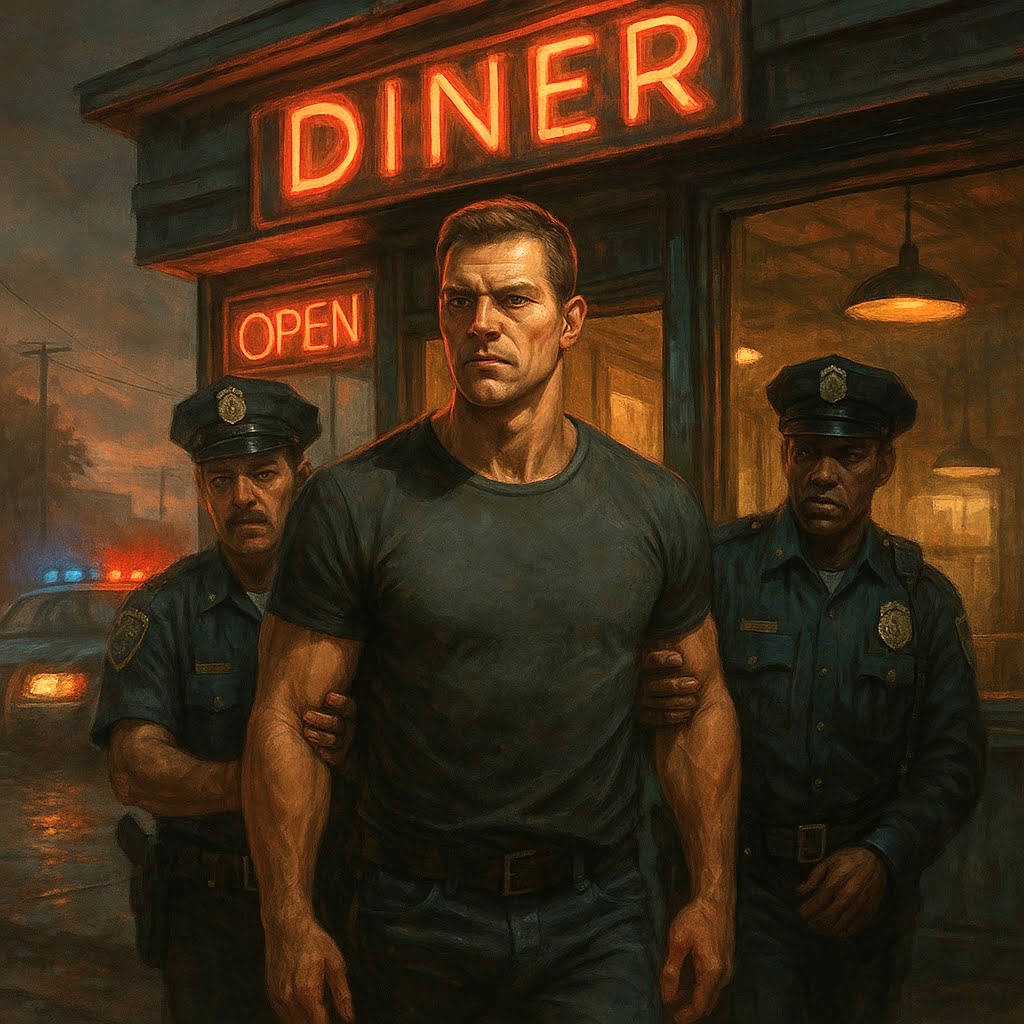
I was first introduced to Jack Reacher by Tom Cruise in the movie Jack Reacher. I can honestly say I genuinely liked that movie, which isn’t surprising because Tom Cruise is a star. The second movie was just okay. While my memory of its opening is hazy, The Killing Floor‘s start in a diner where Reacher is immediately arrested definitely made me wonder if that early movie scene was an homage to this novel. I remember fans of the book series generally grumbling about Tom Cruise playing Reacher, but I didn’t really pay attention to that noise. My second, and much more impactful, introduction to Jack Reacher was Amazon’s Reacher series, which I thought was awesome. I heard someone describe that TV series as “Sherlock Holmes who solves crimes through punching,” and I felt that was a good description.
This means that The Killing Floor was my third introduction to Lee Child’s character, Jack Reacher. And upfront, I have to say I was underwhelmed, and even a little disappointed. Let’s get into it.
We meet Reacher in a diner, finishing breakfast after walking 14 miles from being dropped off by a bus in a small, nondescript town called Margrave. He witnesses police arriving en masse, preparing for trouble before entering the diner. We immediately get an insight into Reacher’s cool intelligence and his ability to assess situations, because he correctly surmises that they’re there for him. It could only be him, a stranger in a small town, with the only other people in the diner being an old man and the employees. This instantly triggers a set of events that propels Reacher into the seedy, rotten underbelly of Margrave.
Published in 1997, The Killing Floor feels a little dated, set in a pre-9/11 world. I appreciate that the TV show updated the story to be more modern-day. For me, the dated feeling was a negative; it didn’t trigger any nostalgic feelings and made it feel unrelatable. Giving the book the benefit of the doubt, it might not have just been the setting – a lone wanderer traveling freely anywhere by bus after leaving the military and then being arrested in a small town isn’t very relatable to me either. Also, it’s the first Reacher novel, so I can assume the series gets better from here.
Reacher is hauled into the police station where he is thoroughly questioned about a murder. He’s interrogated by Finlay, a highly educated detective from Boston who is in Margrave, recovering from a broken relationship. The victim isn’t a local and is hard to identify due to the gruesome nature of the murder. While in the police station, Reacher is constantly assessing everyone around him, always on point. This offers further evidence of Reacher’s exceptional capabilities and experience in such tense situations.
To me, the best part of the book was the introduction where Lee Child shared the history of how he became a writer and how he came up with the character Jack Reacher. Child stated he always admired highly competent characters facing tough situations, and he saw no need for traditional character growth for Reacher. From a character perspective, I find it refreshing to have a very competent character doing smart things, and Reacher demonstrates that throughout the whole book. In the police station, he even helps Finlay with his case because he’s hoping to avoid jail; he’s recently become a wanderer and just wants to get back on the road, not get trapped in this place for the weekend.
In helping Finlay by following a clue, Reacher gets banker Paul Hubble involved, and together they are sent to jail for holding over the weekend. Reacher is mostly annoyed the whole time, genuinely trying not to get involved. While in jail, Hubble leaks information about his involvement, and a hit is attempted, seemingly targeting Reacher, but it’s later revealed Hubble was the true intended victim. They are finally released by Roscoe, a police officer who has taken a liking to Reacher.
Reacher as portrayed in the TV show is a huge man, all muscles. From my gleaning of Reacher content on the internet, this is accurate to the books, but I didn’t really register this in The Killing Floor. Reacher was described as a big guy, but nothing abnormal or huge like I hear he becomes. Just a tall, muscular man. I’m not sure what I was expecting from the description. Again, it’s the first book, so I should be a little more lenient.
Back at the police station and after being cleared of the murder, Reacher makes a shocking discovery, the murder victim is his brother. I knew this fact from the first season of the TV show, but come on. My memory might be fuzzy or glossing over the fact, but I feel like that coincidence was pulled off better. In the novel, his visit to Margrave was purely random, Reacher was only there because his brother had mentioned a musician who used to play there 50 years ago. They weren’t in constant communication, I take it it’s hard for Reacher to maintain close relationships, and Reacher had no clue what his brother was up to. He didn’t even know that his brother worked at the Treasury Dept. on counterfeiting.
I don’t want my synopsis to get too long, so I’ll be more succinct going forward. The victim being his brother gives Reacher a personal mission, and now he’s on the case. The next victim to turn up was the chief of police. He was murdered in the most gruesome way imaginable. Reacher suspected he was a bad guy from the beginning because he’s the one who pinned the murder on Reacher and railroaded him to jail. As a lone wanderer, Reacher made a perfect fall guy. The police chief and his wife were killed in a way that was meant to send a chilling message. Reacher correctly surmised this message was intended for the next chief of police, who turns out to be the mayor.
Reacher stayed with Roscoe, and because of their budding “romantic” relationship, they weren’t home when a kill squad came for them. Reacher went to find Hubble and found evidence of Hubble being caught by the kill squad. He put Hubble’s family into protective custody with FBI agent Picard, whom Finlay recommended. Slowly, it is revealed that a family called the Kliners moved to town. They bought up warehouses and started the Kliner Foundation, which was giving out money to the townsfolk. Reacher had noticed how pristine the town was when he walked around, and he also commented on how empty it seemed, no tourists, no activity to generate the money needed to maintain the area. All clues that the Kliner Foundation was corrupt, and the town was willing to turn a blind eye at best, or participating at worst.
It all goes back to Reacher’s brother, who was investigating counterfeiting in the US. The actual criminal conspiracy was pretty inventive and, I would say, very novel when The Killing Floor was published in the late 90s. I would say the actual crime was the most interesting part of the book and how they were executing it.
Reacher knew they must be counterfeiting but couldn’t figure out the full scheme for the longest time. It was only after he tricked an informant for the Kliners into sending a kill squad into a trap that he fully figured it out. Reacher taking out the kill squad was the second big action point in the book. I would rate the fun of this action on the low end. Reacher as a character is meant to be real-life competent, not an over-the-top character that makes these types of action scenes fun. It read like a checklist of things to do, and then five guys were all dead thanks to Reacher. I mean, he just murdered them without remorse, rationalizing it as justice for his brother.
Reacher didn’t have any fun quirks, other than loving coffee (but who doesn’t love coffee, am I right?). He’s very mechanical and a soldier. That’s not bad in and of itself, and I feel like this is a real person, but it lacked a fun element for me. Reacher finally figures out the counterfeiting scheme by reading through Hubble’s books, looping in Finlay before the final reveal of Picard, the FBI agent, was in on it the whole time. Bum bum bum. I wasn’t shocked at all; it was telegraphed throughout the book due to Reacher’s expert analysis on how many people were involved based on the evidence, and Picard being the only other major character of note. It felt like a very typical TV cop show reveal, the most famous actor turns out to be the murderer, who could have guessed?
Anyway, Kliner and Picard tell Reacher he has to find Hubble before Sunday morning, giving us a ticking clock. Reacher, who had thought Hubble was dead, initially believes they are bluffing about Hubble’s whereabouts. They up the threat level, and Reacher leaves with Picard to find Hubble. Reacher gets rid of Picard (by shooting him) and is able to track down Hubble because Hubble is new at this, and Reacher is an expert. Together they free Finlay and go to the warehouses for the final confrontation.
The three men launch a stealth assault on the warehouse, freeing Hubble’s family and eliminating the criminals with lethal force. Feeling alienated from the community, Reacher ultimately goes back out on the road alone, setting the stage for his nomadic future.
I have to believe the series gets better from here. There are currently 30 books in the series, it seems to have a loyal fan base, and the TV show is pretty great. This book just wasn’t for me. I just didn’t feel the threat of the bad guys. A lot of the menacing action happened off-screen, and Reacher was in control of all the situations except when Picard walked in with a gun. The state of the dead bodies was what we were to use to grasp that the bad guys were truly bad. And if this was a visual medium, I think it would have worked better.
What do you think? Should I keep on reading the Reacher series? Is there a book I should jump to, or should I keep going in order? Let me know in the comments below!

 using WordPress and
Comments are closed