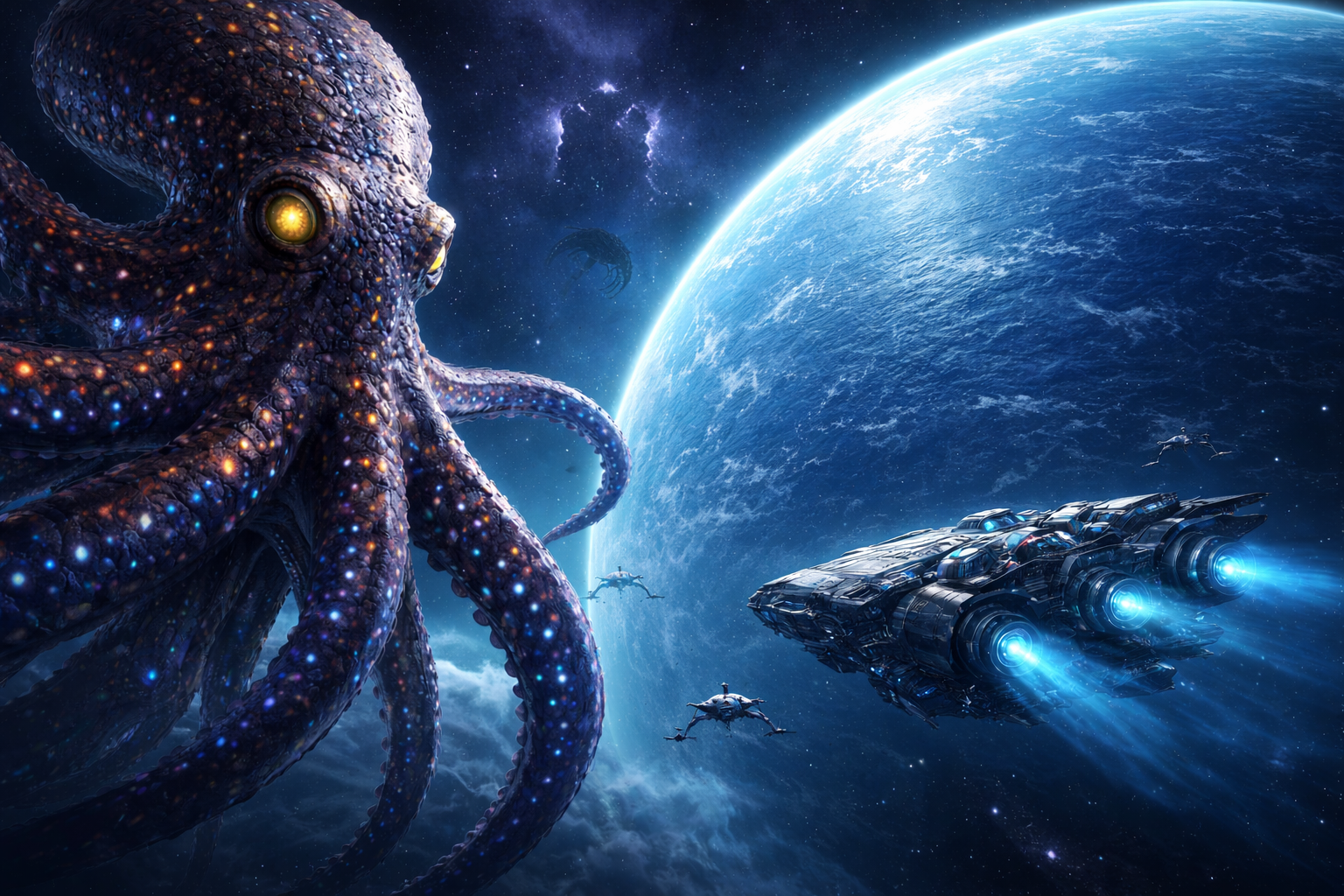
Exploring Alien Intelligence
I loved Children of Time so much that picking up the sequel, Children of Ruin, was a no-brainer. This second installment in Adrian Tchaikovsky’s Children of Time series takes the high-concept world-building of the first book and pushes it into even weirder, darker territory.
While the first book wrapped up beautifully, it left a tantalizing loose thread: the discovery of another human signal. This leads our new alliance of humans and spiders to venture out into the void to see what survived the fall of the Old Empire. To be honest, I went in with few expectations—the first book spanned millennia and felt complete—but I was incredibly excited to dive back in.
A Mission Built on Old Mistakes
Just like its predecessor, Children of Ruin utilizes two braided timelines to tell a grander story. The “past” narrative takes us back to the golden age of Earth’s terraforming efforts, running parallel to the events of Children of Time.
While Dr. Avrana Kern was busy with her monkeys (and eventually spiders), another terraformer, Disra Senkovi, was assigned to System Tess 834. The crew faces a moral dilemma: one planet is perfect for habitation but already hosts native life. Balking at planet-scale biocide, the team splits. One group attempts to transform an icy world into an ocean planet (Damascus), while the other stays near the life-bearing planet (Nod) to study a biology so alien it defies human categorization.
Then, the “Great Collapse” hits. A viral signal from Earth crashes their systems, leaving the crew stranded. It’s a chilling setup—a sealed ecosystem of dwindling options and compounding consequences.
Nod and the Horror of Speculative Biology
On the planet Nod, Tchaikovsky pivots from hard sci-fi into genuine psychological horror. The expedition encounters an infectious agent that doesn’t just kill; it rewrites the mind. It is a collective intelligence, a hive-mind “We” that absorbs organic matter and memories.
What makes it terrifying is its simplicity. Once it gains access to human tool-use and cognition, it fixates on a singular, sacred imperative: “We are going on an adventure.” Watching “first contact” collapse into body horror was a highlight for me. This entity isn’t fully conscious; it’s on the precipice of self-awareness, driven by an insatiable hunger to consume and expand. It doesn’t play by our rules of individuality or selfhood.
Damascus and the Evolution of Uplifted Octopuses
On the icy world of Damascus, Senkovi decides to play god with his favorite pets: the Common Octopus.
Tchaikovsky is a master of speculative biology. Unlike the accidental evolution of the spiders in book one, Senkovi actively “uplifts” the octopuses using the virus. He leans into their decentralized nervous systems, where arms can think independently of the brain. The result is a society based on fluid emotions and color-based communication rather than rigid hierarchy. These uplifted octopuses feel truly alien yet scientifically grounded.
The Present Day: A System Defined by Trauma
In the “present” thread (thousands of years after Children of Time), the human-spider alliance arrives at Tess 834 expecting archaeology. Instead, they find a system fractured by fear.
The spacefaring octopuses don’t see them as friends; they see them as a threat. Meanwhile, on Nod, the ancient entity has never stopped wanting to leave its gravity well. The mystery of how the octopuses have survived and how they’ve repurposed Old Empire tech is gripping.
Collision Course: The Nature of Sentience
The plot escalates through cycles of misunderstanding. The octopuses’ hostility is a defense mechanism against an ancient trauma, while the explorers’ persistence is driven by that same “adventure” impulse that destroyed the Old Empire.
The tension in the final act is incredible: How do you defeat an enemy that doesn’t negotiate and views all life as raw material for replication?
The Verdict: A “Star Trek” Ending
Without spoiling the ending, I loved that Tchaikovsky didn’t go for a simple military victory. It moves toward a hard-earned re-stabilization. It felt like a classic Star Trek ending, surprising, inevitable, and deeply satisfying.
While I slightly prefer Children of Time (simply because I’m a fan of the spiders!), Children of Ruin is a brilliant contemplation on what it means to be sentient. Whether it’s spiders, humans, or erratic, multi-limbed octopuses, Tchaikovsky proves he is the king of modern sci-fi world-building.
What do you think of Tchaikovsky’s work? And if you could choose, what creature would you like to see “uplifted” in a science fiction novel? Let me know in the comments below!
 using WordPress and
No responses yet