The Most Star Trek Book in the Children of Time Series
It is time for the third installment of the Children of Time trilogy by Adrian Tchaikovsky! (If you need a refresher, be sure to check out my previous reviews of Children of Time and Children of Ruin). Wait, what’s that? It’s not a trilogy anymore, but a full-blown quadrilogy with the latest release of Children of Strife? My to-be-read pile is already tilting, but I have to place this book on the tippy top.
But in all seriousness, how do I become one of those elite advanced readers who gets early copies to review? This is a direct call-out to all the ClayReaders out there: I am on a mission to become a massive book influencer, and I need you to relentlessly promote the blog. Get the word out! Tell your friends! Tell your local librarian! Help me get on those publisher mailing lists!
But until my glorious book-influencer dreams become a reality, we have a mind-bending story to discuss. In the meantime, let’s review Children of Memory. Let’s just dive right in.
The Star Trek Vibe & Welcome to Imir
I would sum up my review of Children of Memory as the most Star Trek-like episode of the Children of Time books. I hope that becomes clear as you go through my review.
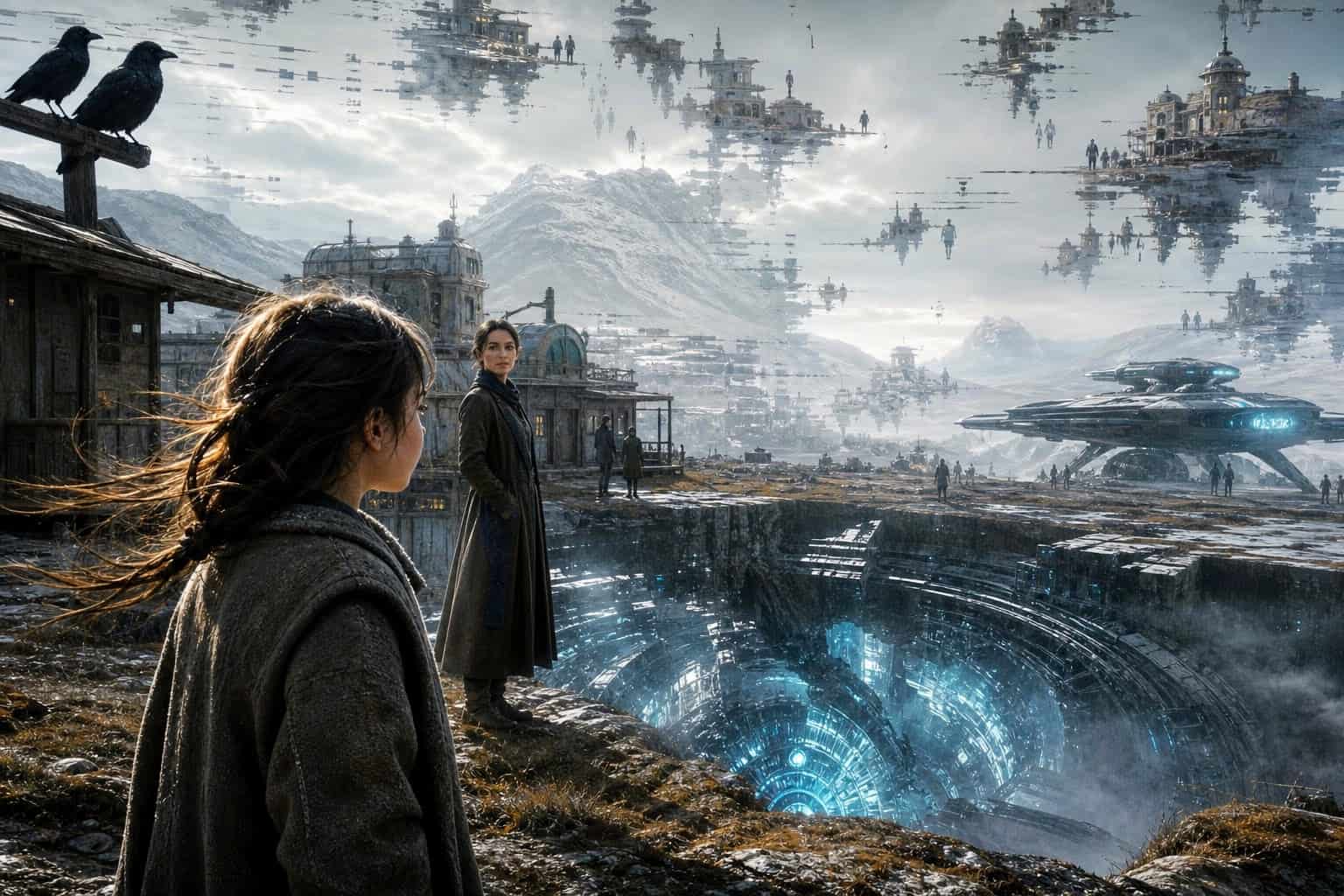
The novel begins on Imir, a world that was supposed to become a human refuge after the fall of Earth. Long ago, the ark ship Enkidu carried colonists there under the leadership of Heorest Holt, but the world that survives in the present is not a thriving paradise. Instead, Imir is home to a small, struggling colony that has lost much of its technological heritage and lives with a constant sense of hardship and limitation.
Liff, the center of the story, is a girl growing up in this colony. Through her perspective, the reader sees a society that feels intimate and closed off, the kind of place where everyone knows everyone else and outside change is deeply disruptive. Liff also carries an unusual relationship to memory and family history, particularly through her connection to her “grandfather,” which helps establish early on that something about this world does not fit together in a normal way. I really liked her character. As a reader, you find yourself having the exact same reactions she has: confusion and a nagging feeling that something is really wrong, even if you can’t quite figure it out.
Prefer to listen instead of read? 🎧
Get the audiobook version of our favorite reads for FREE when you try Audible Premium Plus.
Start Your 30-Day Free TrialAs an Amazon Associate, ClayReads earns from qualifying purchases.
A Glitch in the Matrix
Explorers from the previous book have arrived at Imir to investigate. The most noteworthy is Miranda, who enters the colony in the guise of a teacher and gradually forms a bond with Liff. Miranda is the entity from the Nod that, at the end of Children of Ruin, decided to explore the universe in the “human” way instead of just consuming everything.
From there, the book becomes increasingly strange. The crew, which includes Dr. Avrana Kern, Portia, Fabian, Bianca, and Paul, finds that Imir is not simply backward or decaying. Instead, the colony is haunted by unexplained discontinuities. Events do not always unfold consistently. Time feels slippery. Memories are unreliable. There are odd resets and fractures in the narrative itself, and even the visitors begin to lose their grip on what is actually happening.
At the same time, fear spreads within the colony, where suspicion of outsiders and belief in hidden threats start pushing the community toward paranoia and breakdown. Furthermore, there is a strange power source buried in the planet that the crew can’t account for. Miranda and Dr. Kern go to the planet to figure out what is going on. Dr. Kern is placed in the colony’s repeating storyline as a witch, while Miranda acts as a teacher as events repeat in different variations.
🚨 SPOILER WARNING: The rest of this review dives into major plot reveals for Children of Memory. Read at your own risk! 🚨
The Meaning of Sentience
As Miranda gets closer to the truth, the novel reveals that the apparent reality of Imir is built on a false foundation. The original colonists did not successfully establish the living settlement the current inhabitants believe they descend from. Instead, the landing failed, and the world Liff knows is part of a simulation being run by a machine. That machine has been repeating and preserving versions of the colony again and again, creating a looping existence constructed out of memory, loss, and incomplete survival.
The glitches and contradictions that have been mounting throughout the book are signs that this simulation is breaking down under the pressure of outside contact. This revelation changes the meaning of everything that came before. Liff is no longer simply a child in an isolated colony. She is one of the beings produced and sustained inside the simulation. Miranda and the others are forced to confront a much harder question than whether they should intervene in a simulated society. They must decide whether the simulated people of Imir count as lives in their own right, whether the machine running the simulation is itself a form of intelligence, and whether pulling people out of that system would be an act of rescue or destruction.
The ending turns on choice. Miranda ultimately allows Liff to decide rather than imposing an answer from the outside. Liff does not choose a simple escape or a straightforward rescue. Instead, she reaches back to connect with the Engine itself, establishing a profound, mutual recognition of sentience between the simulation and the created. The crew even mentions finding more of these alien machines buried on other planets, their original purpose still unknown.
Final Thoughts
Like the previous two books in the series, this is a profound meditation on the meaning of sentient life. The first book asked us to consider spiders, something humans instinctively find terrifying. The second focused on octopuses and an alien fungus, whose thought patterns are deeply alien.
Children of Memory adds a fantastic new layer to this. We are introduced to the uplifted Corvids (crows and ravens operating in pairs who constantly, and hilariously, debate whether they are actually sentient or just perfectly mimicking it). Finally, the book poses its ultimate question: could a virtual creation woven from the memories of potential human colonists be truly alive? Seeing a species struggle up the sentient ladder only to be lifted by external forces is a fascinating moral puzzle.
That specific ethical dilemma is exactly what makes this book feel like the most clear-cut Star Trek episode of the series, aided by its beautifully self-contained narrative.What do you think? Have you read this book and if so, did you get Star Trek vibes? Let me know in the comments below!

 using WordPress and
Comments are closed