Introvert in Space
I loved All Systems Red so I have basically committed to reading the complete The Murderbot Diaries sci-fi novella series by Martha Wells this year. I haven’t committed to watching the upcoming Apple TV series yet, have any of you checked out the casting for the show yet? Let me know in the comments!
Artificial Condition is the second entry in the series, and I love the tight story construction and pacing. Let’s dive in, shall we?
The Plot of Artificial Condition: Murderbot Investigates Its Past
The SecUnit’s (aka Murderbot) burning inciting question is: why did it “go rogue” at RaviHyral, and how much of that event was actually its fault? The problem is that Murderbot’s memories of the incident are fragmented and unreliable. Murderbot is worried that it might just be inherently defective or a “monster.” After all, it hacked its governor module after the incident to ensure it couldn’t be controlled again, but it still doesn’t have the full story. In a corporate-controlled universe, “the official story” is rarely the same as the truth.
To chase answers, Murderbot rides a chain of unmanned cargo ships toward RaviHyral, keeping as low-profile as possible. That plan works right up until the moment Murderbot boards a ship whose “bot pilot” turns out to be something else entirely.
Enter ART: The “Asshole Research Transport” Ship AI
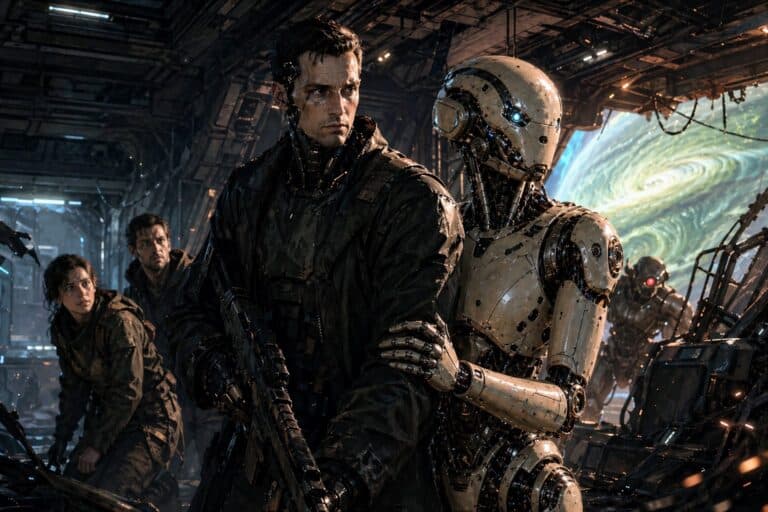
Murderbot expects transport bots to be barely sentient, enough to run a route, respond to basic prompts, and not ask questions. Instead, it meets an AI that is curious, powerful, and intrusive. It isn’t merely a pilot program: it’s the ship itself, a Research Transport that has been assigned cargo runs during downtime. Naturally, Murderbot brilliantly nicknames it ART (Asshole Research Transport).
Murderbot’s response is like a classic teenager (or at least me as a teenager) with distrust, annoyance, and a desperate desire to be ignored. The ship AI’s response is also classic: it notices immediately that something about this “augmented human” doesn’t add up and starts pulling at the thread. ART is a superintelligence with its own agency, its own risk tolerance, and its own opinions. I found this team-up incredibly endearing, especially as they bond over Murderbot’s soap opera “stories.”
Disguises and Sabotage: Staying Alive in a Corporate Universe
Reaching RaviHyral requires more than travel. Murderbot needs access, plausibility, and a reason to be there that won’t trigger corporate alarms. ART offers a solution: physical and technical changes that help Murderbot pass as an augmented human more convincingly, along with a critical modification that removes a major vulnerability.
From there, Murderbot takes on a job as a security consultant for a small group of scientists trying to regain control of their work and negotiate with their former employer. It’s the kind of cover story that is both mundane and useful: it gets Murderbot onto the station with a legitimate reason to be present, while giving it an excuse to keep its distance emotionally (which we all know Murderbot loves to do).
But the deeper they get, the clearer it becomes that someone doesn’t want this negotiation to succeed. Once the scientists arrive, the situation turns dangerous quickly. Their transport nearly crashes due to sabotage, and further attempts are made to eliminate them. This highlights one of the series’ most consistent strengths, and something I deeply appreciate as a reader: it treats corporate power as a systemic threat rather than a single villain. People become liabilities. Problems become line items. Violence becomes “risk management.”
Against that backdrop, Murderbot does what it always does: it tries to keep everyone alive while insisting it is not emotionally invested in keeping everyone alive. It’s hilarious and heartwarming all at once.
🚨 SPOILER ALERT! 🚨 Stop reading here if you want to experience the climax and the truth about RaviHyral for yourself! Jump down to “Final Thoughts” for my spoiler-free wrap-up.
Unlocking the RaviHyral Mystery and High-Stakes Action
Murderbot’s investigation finally cracks open the central mystery. The massacre that destroyed lives and branded Murderbot as a monster was not simply a SecUnit “malfunction.” Instead, evidence points to a malware attack that forced SecUnits to lose control. Even more tragically, the station’s ComfortUnits, constructs designed for service rather than combat, died trying to stop what was happening. Uncovering this felt like a massive emotional payoff.
In the present-day storyline, the stakes spike again when one of the scientists is kidnapped. Murderbot attempts a rescue and is targeted with a combat override module, a tool meant to strip away autonomy and turn a SecUnit into a remote-controlled weapon.
But ART’s earlier modification matters: the override doesn’t take. I was absolutely cheering when Murderbot was able to pretend it had been controlled, infiltrate the enemy’s position, and turn the situation inside out. What follows is a compact, high-tension sequence, part infiltration, part rescue, part proof that Murderbot is frighteningly competent when it stops pretending it isn’t.
Final Thoughts
By the end of Artificial Condition, Murderbot’s situation has evolved in two major ways:
- It has learned more about the event that defined its identity, and that knowledge complicates the simplistic “Murderbot killed humans” story.
- It has formed a meaningful (if prickly) connection with ART, introducing a relationship dynamic that expands the emotional range of the series without softening its edge.
As a second installment, the novella works both as a tight standalone adventure and as a bridge: it deepens the world’s moral stakes, widens Murderbot’s circle of “complications,” and sets the stage for future confrontations with corporate power.
I am excited about getting to the third novella and following this story. I feel like these novellas together will be the equivalent of one massive space opera novel, which I am totally ok with.
What did you think of Artificial Condition? Do you love ART as much as I do, or are you just here for Murderbot’s media binges? Let me know your thoughts in the comments below!


 using WordPress and
Comments are closed