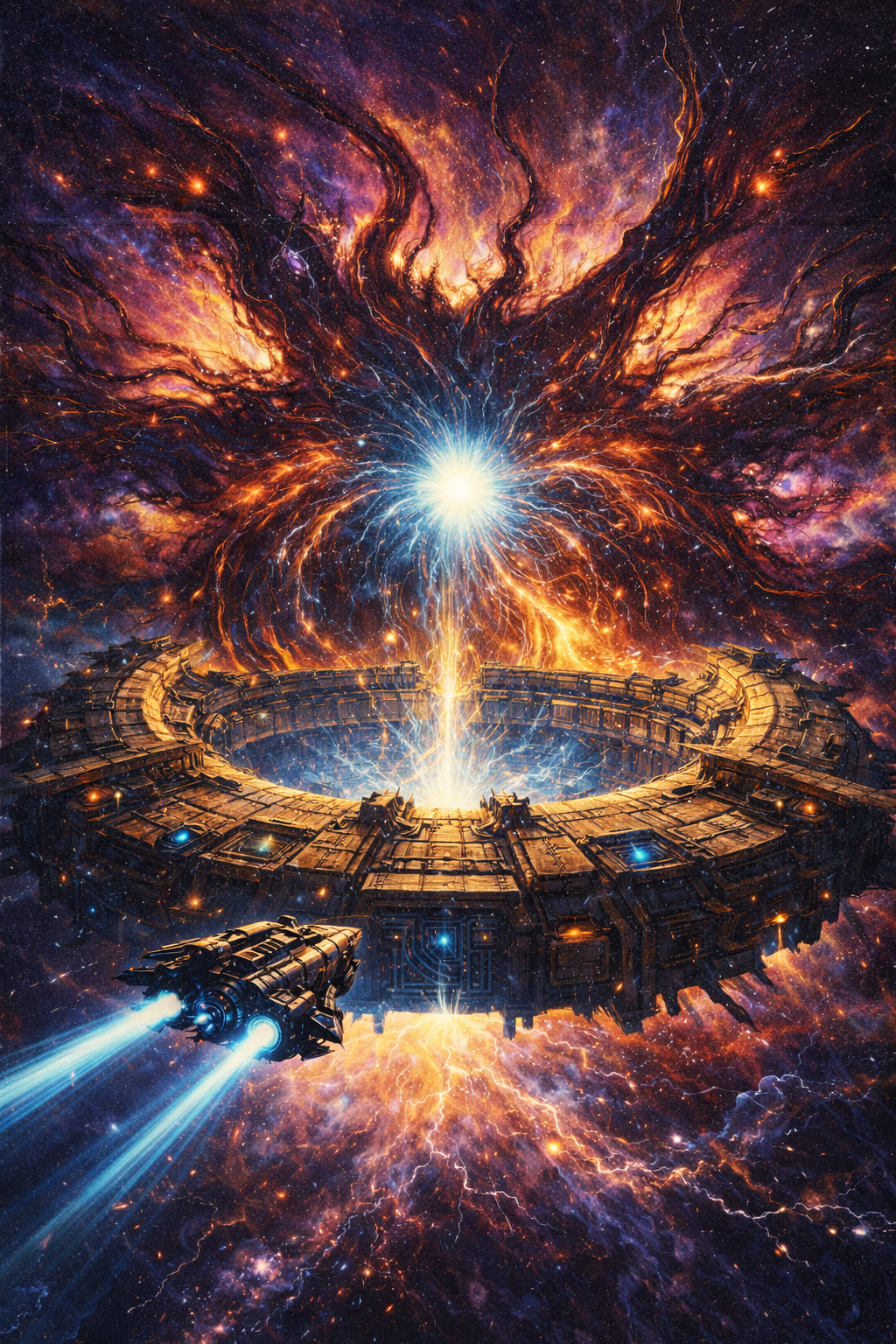
Lords of Uncreation Review: A Fitting End to the Final Architecture?
Lords of Uncreation is the final book in Adrian Tchaikovsky’s Final Architecture trilogy. Since I reviewed Shards of Earth and Eyes of the Void, of course, I had to finish this journey.
There was a point in my life where I would only read finished series. I had several reasons for this. First, I wanted a long-running story that had a clear evolution of characters over time. Second, I wanted to make my next reading decision really easy on myself, I would just go to the next book! If a series had many books, it was usually a good indicator that it was going to be a good read. Seems like sound logic to me.
I found the Final Architecture trilogy interesting for exactly these reasons: a complex universe set up in just two books, interesting power dynamics, a race of truly alien creatures, and a hidden threat that no one understands (except maybe the Essiel).
The Setup
Lords of Uncreation opens pretty much where we left off: an uneasy partnership between factions circling the Originator “Eye,” and the revelation that Idris has discovered a way to strike back at the Architects.
However, Idris opposes attacking them directly. He knows the Architects are being used against their will by a larger, unknown threat deep in unspace, the entity no one wants to admit exists because it drives non-Intermediaries insane.
Tension explodes when a coup ignites around the Eye, led by Ravin Uskaro and Executor Mercy (a rogue Parthenon leader). This shatters the fragile cooperation, turning the Eye into a central battleground. Uskaro and Mercy find common ground in the belief that war with the Architects is futile and that becoming nomadic spacers is the only solution. Mercy revolts against Parthenon ideology, forming a faction of “Ints” who can travel wherever they want.
The partnership dissolves, leaving all our heroes separated and fighting their own paths toward a reunion in the end.
The Stakes
I know this is an epic space opera, but even I wondered how Tchaikovsky was going to wrap up all these storylines. The second novel, Eyes of the Void, made a massive promise: to reveal who is really behind the Architects’ destruction of inhabited worlds and why.
That is a big promise to pay off. Tchaikovsky immediately raises the stakes by dissolving the very coalition set up to fight that threat.
⚠️ SPOILER WARNING ⚠️
I am going to jump into spoilers below to talk about the sections I really liked. If you haven’t read the book yet, stop here!
Olli’s Evolution
Before the coup, Olli and Kit are on the Unspeakable Aklu ship. Olli “borrows” an Ogdru named Junior to scout nearby space using the Vulture God, suspecting a Parthenon ambush. She was half right. She returns just in time to save the Unspeakable Aklu, whose ship is destroyed in the surprise attack.
My favorite story arc is definitely Olli’s. She becomes the strongest character over the course of the trilogy and truly finds her place in the universe. Watching her become the Unspeakable Aklu herself, gifted with Essiel technology that makes her god-like compared to other humans, was touching and compelling story line.
Justice and Rebellion
Beyond Olli, I found the justice served to Executor Mercy for her treason, and the final showdown with the big evil, to be the most compelling parts of the story.
Executor Mercy performs loyalty tests on the Parthenon members caught in the coup, including Myrmidon Executor Solace. Solace is having an internal conflict about her role: she believes the Parthenon’s mission is to shepherd and protect humanity, while Mercy believes the Parthenon is peak humanity and no longer needs to protect what she deems a “subspecies.”
Solace wrestles with this and concludes she must form a rebellion. She is willing to die for what she believes to be a righteous cause to protect the Parthenon. Before she can execute this rebellion, however, her former commander executes a backup plan. He traps all of the rebellious Parthenon on a ship and drives it deep into unspace. Mercy is forced to stare straight into the creature of unspace, never to return.
I like this justice, but I admit I was wanting this moment for Solace to step up and become someone bigger. She was always looking for orders and the comfort of the Parthenon collective; this was the point where she could have become a leader of that collective. Ultimately, I feel like she didn’t quite realize her potential.
The Final Battle
The other major moment is the finale. Idris has Kit make a plea for him, convincing everyone that they shouldn’t attack the Architects and should instead go directly to the source.
They dive deep into unspace. It turns out that the “big bad guys” are protected by a monster, the very presence that causes everyone to feel hunted when they enter unspace. This final battle is a moment for Idris and Solace to come together and become more than they were alone.
We learn that the center of unspace is the center of the universe, inhabited by the creators of this reality. They are trying to reshape the universe into a place where they can live, but intelligent life is “messing up” their plans, which is why they are striking out with the Architects. I thought this was a cool concept and well conveyed. It was a bittersweet ending where both Idris and Solace got their moments, and the universe was saved.
Final Verdict
This was my favorite of the Final Architecture trilogy and it wrapped up nicely. Bad guys got their comeuppance, good guys got happy (if not sad) endings.
I highly recommend this trilogy. I also recommend Children of Time if you haven’t read it yet.
What is your favorite sci-fi trilogy? Let me know in the comments below.

 using WordPress and
Comments are closed