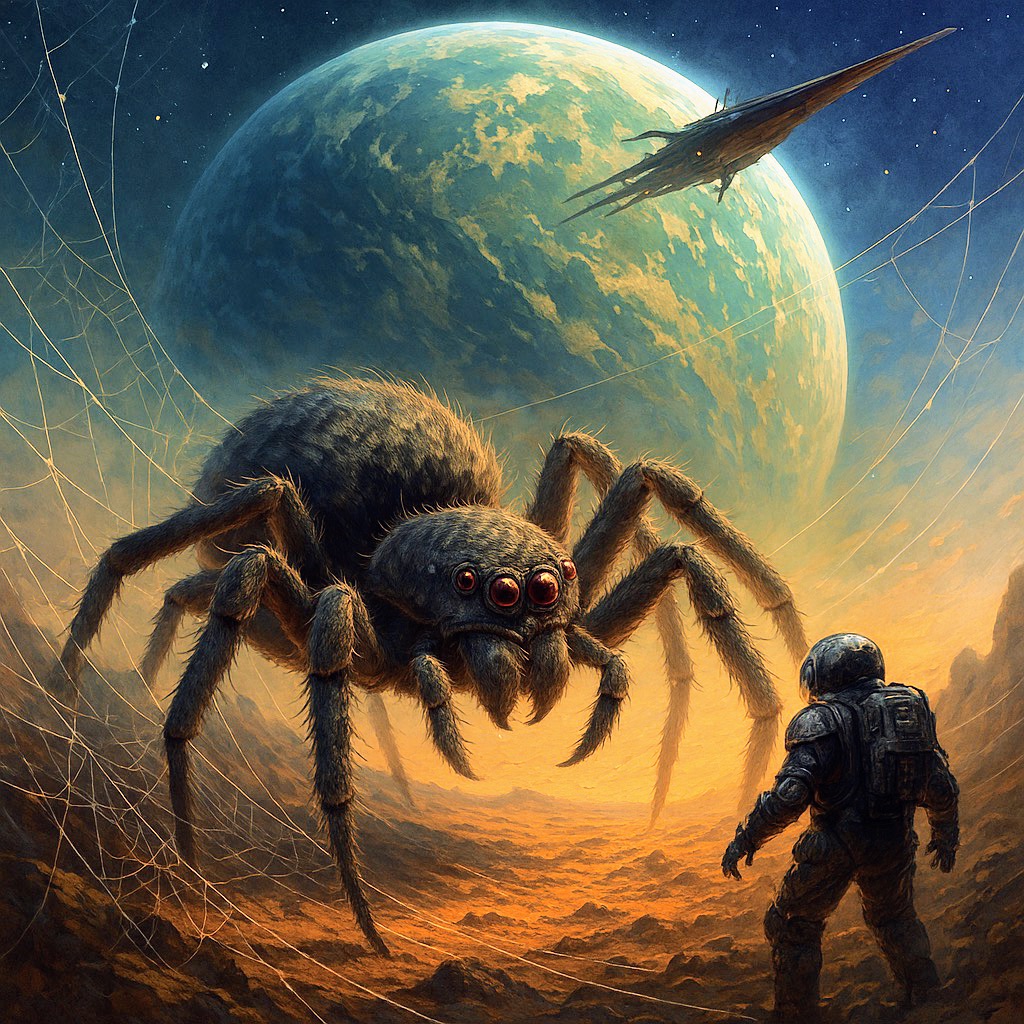
A Mind-Bending Sci-Fi Masterpiece
Children of Time by Adrian Tchaikovsky was recommended by a coworker and sounded interesting, so I picked it up to read. Turns out, by coincidence, my neighbor was already reading this book as well! There were a lot of in-person conversations around this book, which for me, makes reading so much more enjoyable. I don’t get that a lot, and it’s probably why I started ClayReads.blog, just to have someone to talk about my books with, even if it’s myself.
If you are looking for one of the best sci-fi book recommendations out there, look no further. I think my friend sums up Adrian Tchaikovsky novels perfectly… he gets weird. Let’s dive in shall we.
The Fall of Humanity and the Rise of Kern’s World
Children of Time is about the collapse of Earth and the human space empire at the hands of anti-terraforming terrorists, and what grows from the seeds in those ashes. We start with Dr. Avrana Kern, who is, if I’m being honest, a stereotypical science fiction scientist with a god complex because she thinks she’s smarter than everyone around her. She has helped with Earth’s terraforming project, though her true aim is evolving a new intelligent species using a nanovirus she created to uplift monkeys.
Dr. Kern is in her orbital station, about to complete her dream, when a terrorist sabotages the science station in orbit. This causes everything to go wrong. Meanwhile, a separate and galactic terrorist attack unleashes a signal that corrupts all of human technology, sending humans back to the Stone Age. Dr. Kern, protected within her specialized orbital laboratory, and the nanovirus she deployed on the planet below, are among the few things that endure the immediate aftermath. I would love to read a prequel story that leads up to this event: What was the reasoning behind this attack? And what caused such a drastic escalation to convince humans to essentially wipe out humanity?
Prefer to listen instead of read? 🎧
Get the audiobook version of our favorite reads for FREE when you try Audible Premium Plus.
Start Your 30-Day Free TrialAs an Amazon Associate, ClayReads earns from qualifying purchases.
The Accelerated Evolution of Spiders
We fast forward through thousands of years, following the profound impact of Dr. Kern’s nanovirus and how it affected the indigenous population of spiders, dramatically accelerating their evolution. Over this time, Dr. Kern revives periodically to check on the state of her grand experiment below. While she initially assumes her nanovirus has uplifted monkeys, it’s the highly intelligent spiders that have flourished. Her distant transmissions and the very nature of the uplift process inadvertently shaped aspects of spider society, including their nascent religion.
I really love how these spiders solve their problems, using their natural biology to create technology, pass down memories, tame ants that threaten to destroy them, and even use those ants to create organic computers.
The main spider protagonists we follow are Portia, Bianca, and Fabian. Because the story spans millennia, these names act as recurring narrative archetypes for different versions of the same spider lineages over thousands of years. Portia is the brave explorer, Bianca is the astute leader, and Fabian is the nerd underdog who fights for his place in spider society. When I first read this, I wondered why Tchaikovsky chose these specific names, assuming they were just high-society human names. It turns out, there is a brilliant scientific easter egg here: Portia is the actual real-world scientific name for a genus of highly intelligent jumping spiders! Tchaikovsky used this real genus as the foundation for his alien society.
A Dual Narrative: The Gilgamesh
Meanwhile, we follow the last surviving humans on the arc ship called the Gilgamesh. They escaped the final collapse of Earth, looking for a terraformed planet that could support humans in cryogenic suspension. It’s humanity’s last hope.
The protagonist we follow is Holsten Mason, a classical historian (classical in the sense of human history thousands of years in the future), whose only value is to help decipher ancient Old Empire records and provide historical context. The Gilgamesh is commanded by Captain Guyen, whose main mission is to lead the surviving humans to a new habitable world.
The Gilgamesh eventually arrives at Kern’s World and is promptly rejected by Dr. Kern. Increasingly integrated with her station’s AI systems and fiercely protective of her evolving experiment, Dr. Kern views these arriving humans as a potential contamination. She refuses them access to her planet and uses her formidable orbital defenses to violently repel them. Because of their weakened ship and lack of weapons, the Gilgamesh decides to try another possible terraformed planet instead of fighting.
The second planet the Gilgamesh arrives at is a terraforming failure. It’s toxic, unstable, and completely uninhabitable. But they find some Old Empire technology that they scavenge. The only possible survival is Kern’s World, so the Gilgamesh goes back to take the planet by force. On the way back, Captain Guyen goes full authoritarian. He attempts to upload his consciousness into the Gilgamesh computers to maintain full control until the mission is completed. The process, exacerbated by the salvaged technology, profoundly alters his personality, transforming him into a ruthless, almost cult-like commander. This causes an eventual mutiny to overthrow him and get the mission back on track.
A Mind-Bending Sci-Fi Conclusion
These storylines meet at the climax of the Gilgamesh returning to Kern’s World. By this time, Dr. Kern has learned the truth of her experiment, and the spiders have learned the truth of Dr. Kern. The spiders have been warned by the orbital station and advised to take extreme measures to repel the humans from invading their planet.
The dynamic of intelligent spiders and humans is fascinating and triggers a visceral reaction when imagining millions of huge spiders living in a complex society. As the conflict progresses and spiders in spacesuits created out of spider silk attempt to board the Gilgamesh, I was truly at a loss for how the outcome would resolve. It is one of those situations, which I think Tchaikovsky set up perfectly, where you are rooting for both sides of the conflict.
💥 🕸️ [MASSIVE SPOILER INBOUND!] 🕸️ 💥
What happens next is pure brilliance. Rather than ending in a destructive war, it’s the spiders themselves who solve the crisis. Using their advanced biological sciences, the arachnids modify the original uplift nanovirus and deploy a custom-engineered biochemical agent on the humans. This agent is designed not to destroy, but to neurologically integrate humans into the new paradigm. It specifically overrides the humans’ instinctual, “lizard brain” terror of spiders, forcing them to feel empathy and perceive the spiders as partners to share the planet with, rather than a threat. This is the exact same sophisticated method the spiders used to “tame” and integrate the ant threat into their society. It resolves the conflict in an incredibly satisfying, non-violent way that I highly enjoyed.
Final Thoughts on Children of Time
There are a lot of aspects I loved about this book. I loved the time dilation and how it was handled by jumping between the humans on the arc ship Gilgamesh and the evolution of the spider society. I liked how we followed along with the spiders as they evolved and overcame existential threats. And I loved how they solved the “human” problem at the end, it was a surprising but inevitable conclusion. Those are the best sort of twists that provide a satisfying intellectual payoff.
The spiders’ names were a great touch of scientific realism, the scope of the universe was immense, and even Dr. Kern becoming more AI than megalomaniac human scientist was highly enjoyable. This was a fantastic introduction to the works of Adrian Tchaikovsky.
This was an immense science fiction novel, and I don’t feel I really did it justice in just one review. I highly recommend Children of Time for any fan of the genre.
For those who’ve read it, what was your most mind-bending moment in Children of Time? And if you haven’t, what’s a sci-fi book that completely reshaped your perspective or introduced you to a truly unique alien species? Let me know in the comments below!

 using WordPress and
Comments are closed