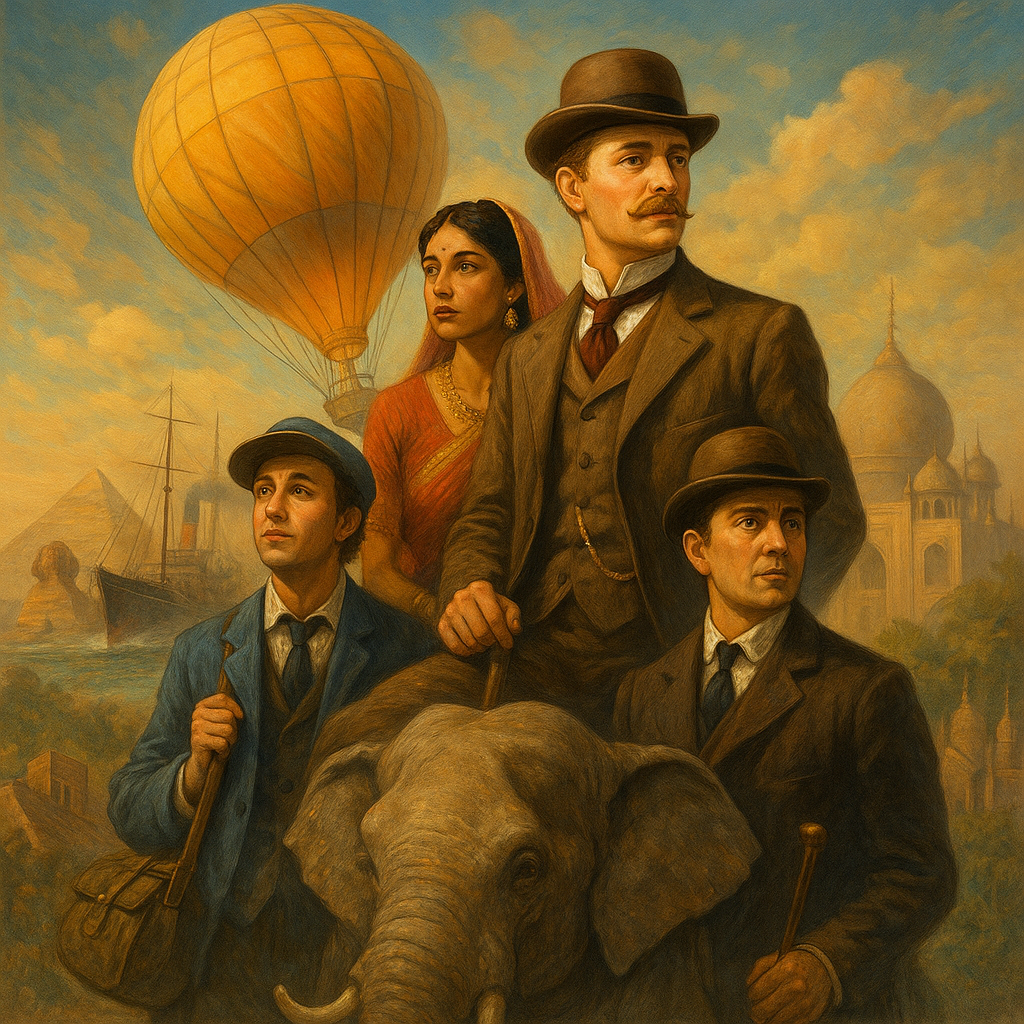
Around the World in Eighty Days by Jules Verne
Around the World in Eighty Days was my third Jules Verne book, having previously read 20,000 Leagues Under the Sea and The Mysterious Island. Spoiler Alert: this was my favorite book written by Jules Verne I have read so far! I thought it was incredibly fun and truly inspired me to put a trip that circles the globe on my bucket list.
Here comes my disclaimer: I recognize there are anachronistic portrayals of different cultures in this novel that are not accurate and probably fall into the racist bucket. I’ll chalk this up to the time period this was written in and the stereotypes that were used to communicate shorthand ideas to audiences back then. However, unlike 20,000 Leagues Under the Sea, which had what I took to be a serious ecological message and undertones of ecoterrorism, and The Mysterious Island, which at times read like a survival manual, this one made me feel the pure enjoyment of being a kid. It was exactly what I would want from a fun Jules Verne story. So, for the purpose of this review, I’m focusing on that enjoyment.
Around the World in Eighty Days introduces us to an English gentleman named Phileas Fogg, who makes a wager of £20,000 with his club colleagues that he could circumnavigate the globe in eighty days. This sum represents what Fogg believes he would need to cross the world in that time, and basically, his entire fortune. It’s a very straightforward premise with a slightly annoying protagonist, his detached and methodical nature, even in the face of incredible obstacles, can be a bit exasperating. He is accompanied by Passepartout, his new valet, as they set off from London by train to catch a steamship to France. The steamship was slightly delayed, a subtle foreshadowing of the unpredictable journey ahead.
They travel by train to Italy, where they board a steamer to sail through the Suez Canal. The Suez Canal had only been open for a few years when Around the World in Eighty Days was published, which I assume made its inclusion even more thrilling and exotic to initial audiences. In Egypt, Fogg and Passepartout pick up a tail: Detective Fix. Fix, having received a communiqué about a bank robbery, suspects Fogg and begins to tail the travelers, embarking on his own parallel journey across the globe. The team leaves Suez for Bombay on … another steamship.
In Bombay, they head towards Calcutta using, predictably, a train. On the way to Calcutta, Fogg and Passepartout encounter the unexpected problem of the railway not being finished. Did that actually happen back then? Could you really get on a train and not reach your intended destination because the tracks weren’t completed? That would be wild! This doesn’t disturb Fogg in the least, as he does what anyone with his single-minded focus would do in this situation: buys an elephant and hires a guide. On their elephant journey, they encounter Aouda, who is about to be sacrificed in a sati ritual. This is where the story becomes a little questionable in its cultural sensitivity to Hindus. Letting that slide because of the era in which it was written and in traditional Western heroism, Fogg saves Aouda, who is grateful that she didn’t have to die in a fire.
Aouda joins the team on the way to Calcutta, hoping to meet up with family in Hong Kong. And yes, the crew hops on a steamer for Hong Kong. Outlining the modes of travel really does a disservice to the story, making it sound less exciting than it is in the reading. Fix is still on the trail of Fogg and company, finally getting a warrant for his arrest in Calcutta and meeting up with them in Hong Kong.
Hong Kong introduces many delays due to weather, and Fix is actively trying to cause trouble, befriending Passepartout and getting him drunk, causing him to miss the boat to Japan. No worries though, Fogg and Passepartout eventually meet up again in Japan to head to the new world. Aouda is still tagging along, having not found her family in Hong Kong. Fogg, being an English gentleman, in what would probably be considered a demeaning move now, says he would look after Aouda, and she should accompany him on his journey. Of course, this causes Aouda to start being fond of Fogg, marking the beginning of a sweet and innocent romance.
Once in San Francisco, the trio gets onboard a train to New York, with Fix still tagging along. On the way to New York, the train is attacked by Sioux warriors, and Passepartout is captured. Fogg takes a significant detour to save his valet from the Sioux—a great sacrifice, as Fogg’s fortune is on the line. After the rescue, the team comes across a damaged bridge, requiring another improvisation by Fogg: inventing a wind-powered sledge that allows them to make up for lost time. At this point, Fix has truly become a part of the crew, actively helping them on their journey and becoming personally invested in its success.
Finally in New York, Fogg misses the steamer to Liverpool, so he charters his own private ship to get them there on time. Once in Liverpool, this is where Fix finally has the opportunity to arrest Fogg, delaying him even further from reaching his destination on time, making Fogg think he lost his bet. Fix realizes his mistake when it is revealed the real bank robber was already arrested.
Fogg arrives in London thinking he is late by mere minutes. But not all is lost; Aouda reveals her love for Fogg and proposes marriage, which moves Fogg, and he accepts. Passepartout goes out to arrange the wedding for the next day, where he discovers a brilliant twist: the team forgot to factor in the fact they had crossed the International Date Line, and it was actually a day earlier than they thought! This realization sends Fogg rushing to the club, where he wins the bet. The hero wins and gets love in the end.
Like I said, I thought this novel was a lot of fun. I feel my kinetic retelling of the plot here matches the frenetic pace of the novel. The switch between story lines of Fogg and Fix kept the book fresh and from being boring. I haven’t seen the movie but it is on my list. I am a fan of what I have read of Verne, but this one stood out to me.
What is your favorite Victorian era novel? Comment down below.



 using WordPress and
Comments are closed