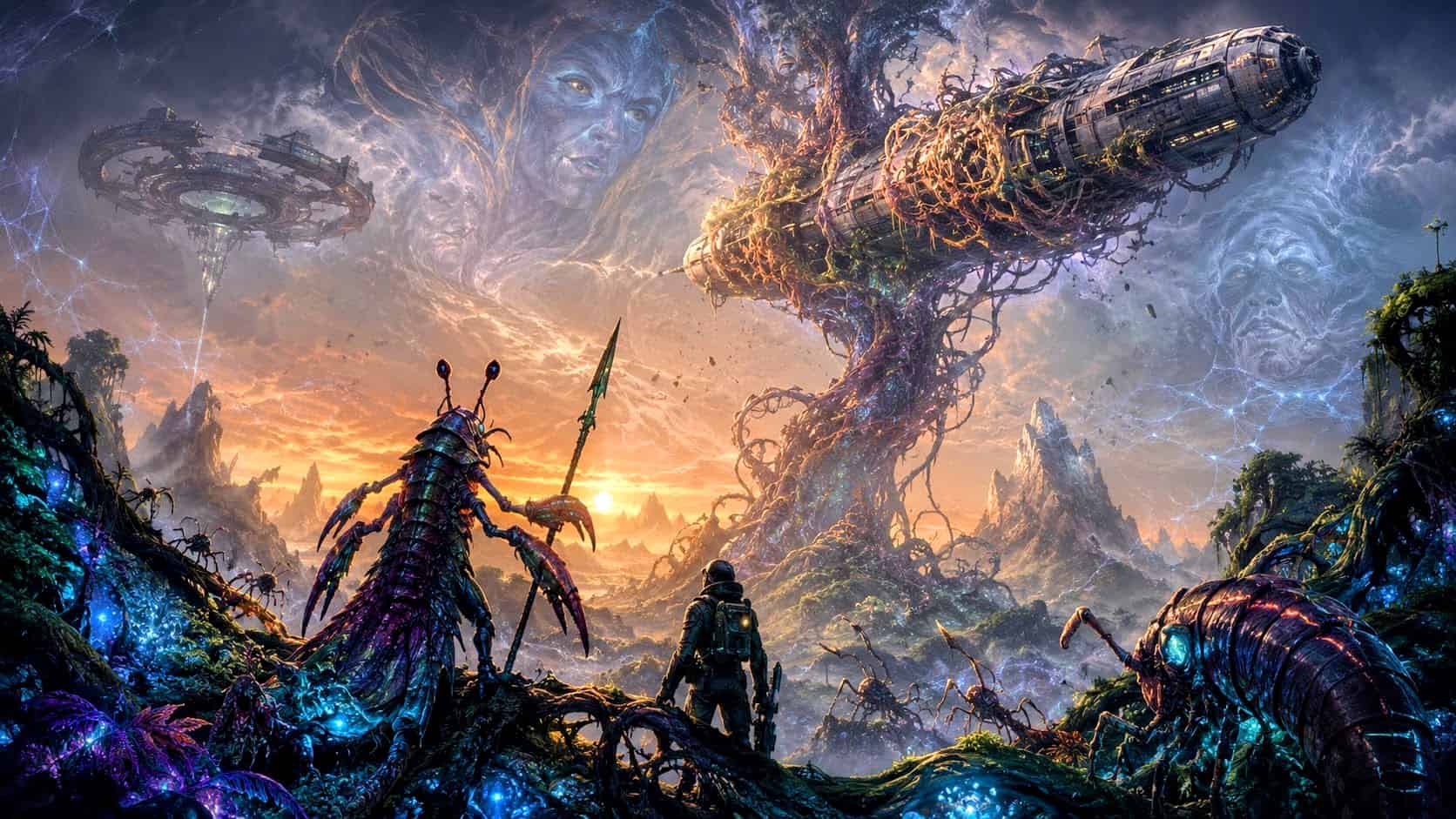
When Terraforming Turns Scientists Into Insane Gods
It’s finally time to review the fourth book in Adrian Tchaikovsky’s Children of Time series: Children of Strife. And oooh man, this was a weird one.
If you’ve a ClayReader, you know I love Tchaikovsky’s themes of sentience, but Children of Strife tackles it from a completely different angle. (Or maybe it doesn’t, I’m no literary critic, I just love talking about books on a blog). Grab a coffee and let’s dive in, shall we?
🚨 SPOILER WARNING: Heavy spoilers for Children of Strife ahead! 🚨
Like the previous books, Children of Strife tells its story across three separated, yet intertwined periods:
- Era One: We follow a renegade group of Old Empire terraformers led by Gerey Hartmand, a wealthy rival of the famous Avrana Kern. From their orbital station, the Pancreator, Hartmand and his four specialists (Redina Kott, Sui Dorcheson, Ken Pil, and Ottis Milner) attempt to terraform a remote planet.
- Era Two: Centuries later, a human ark ship named Marduk leaves Earth for Hartmand’s planet. They arrive to find a gigantic living Beanstalk that promptly begins consuming their ship. The survivors are forced to settle on a hostile planet, completely unaware that the ecosystem is being manipulated by the surviving minds of the ancient terraformers.
- Era Three: In the era of the Panspecific civilization, Alis, a human researcher still psychologically damaged from the alien simulation on Imir, teams up with Cato (an uplifted mantis shrimp) and Avigael Kern. Together, this unlikely crew sets out to discover what actually happened to the Marduk and the Pancreator.
It’s a lot, I know.
Prefer to listen instead of read? 🎧
Get the audiobook version of our favorite reads for FREE when you try Audible Premium Plus.
Start Your 30-Day Free TrialAs an Amazon Associate, ClayReads earns from qualifying purchases.
The Hartmand Timeline: Terraforming Gone Wrong
I’m going to be honest: I found Hartmand’s group of scientists incredibly annoying. They were completely self-centered and fueled purely by envy over Kern’s success. What made it especially frustrating was that this was constantly pointed out by Redina Kott, our main POV character for this team. I wanted to like Kott, she seemed self-aware at first, but she never actually took action to fix her flaws or her situation. Even her eventual “team-up” with Kern at the end didn’t redeem her in my eyes.
Hartmand’s crew is obsessed with proving they have a better terraforming technique than Kern. They keep failing until Ken Pil unlocks a way for the planet to self-evolve using a biological feedback loop based on Kott’s inventions. I honestly didn’t follow the scientific babble here. I am usually more than willing to allow for crazy sci-fi jargon because I enjoy the ideas behind it, but the mechanics of this evolution just lost me.
What it essentially boils down to is that Ken Pil accidentally figures out how to upload his consciousness into the planet’s information network (similar to Kern and her ant-based computer). Kott tries to secretly upload herself, only to find out the rest of her backstabbing team is doing the exact same thing. This was one of those moments where I was screaming at the book, “Come on, can’t we kill any of these losers?”
Instead, they become a literal pantheon of gods, controlling the planet’s evolution with absolutely no higher purpose other than their own sick entertainment.
The Marduk Storyline: My Favorite Part of Children of Strife
The storyline following the Marduk is easily my favorite part of the book. We follow Captain Lamya Cosimir from her initial recruitment on a dying Earth all the way to her disastrous landing at the Pancreator. Cosimir was the absolute ideal captain for this mission, quickly earning her crew’s loyalty and fulfilling her promise to get them to a new home.
It just turned out to be a very bad promise. By the time they arrive, our “pantheon of gods” has already corrupted the local life, acting like ancient Greek deities in their search for novelty and power.
This storyline shows us exactly how twisted the planet’s evolution got and how these “gods” react to actual human survivors. In the first era, Hartmand had left behind a beacon telling Earth’s survivors to come find his new paradise. To see these ancient humans turn on their descendants just to have new playthings felt a little out of character at first. But honestly? After thousands of years of isolation and digital immortality, they probably just went completely insane.
Cato the Stomatopod: A Lesson in Evolution
Cato is a Stomatopod, think giant, uplifted mantis shrimp, that evolved underwater on the same planet as the Portids. Tchaikovsky uses Cato’s warrior-like, futuristic Spartan race to make his main commentary on sentience. Cato’s culture is trapped in a never-ending cycle of battle, unable to evolve into something greater through cooperation.
Cato’s backstory is a harsh lesson in being careful what you wish for. After being uplifted with advanced technology by the Human/Portid society, Cato ends up slaughtering his enemies in a new home system. But the joy of battle turns to ash when he sees himself through the horrified eyes of the Portids. Disgusted by what he’s become, he exiles himself.
I liked his arc. By the end, he evolves past his base instincts, controlling his actions for a cause much bigger than his own pride.
The End of The Pantheon & Final Thoughts
In the end, the pantheon has a standoff with Kern and her team. If there’s one thing you can count on with The Children of Time endings, it’s that they wrap up neatly without any massive, galaxy-destroying space battles. It all comes down to an ultimatum. The pantheon of gods takes the deal, leaving the planet to go somewhere else where they can have endless fun playing creator.
Overall, I still think the original Children of Time is Tchaikovsky’s best book. I cared so much more about the spiders and the humans in that story; following their evolution felt far more intimate. I just couldn’t bond with the characters in Children of Strife, and the self-absorbed scientists were just horrible people.
That being said, I don’t regret reading it! The ideas were cool, crazy, and uniquely Tchaikovsky.
Have you read the full Children of Time series yet? What was your favorite book? Let me know in the comments below!
 using WordPress and
No responses yet